Nuklai's Blockchain: Helix
Overview
Helix is built on the Cosmos SDK framework that enables the creation of application-specific blockchains. This architectural choice allows us to provide a protocol specifically optimized for dataset management, sharing, and collaboration while maintaining interoperability with other blockchains through the Cosmos IBC protocol.
We support the creation, management, and exchanging of datasets in a fully decentralized manner, enabling builders to create trustless data-focused applications on top of Helix. At its core, Helix's implementation leverages (native) NFTs to track dataset ownership and contributions, creating a great system for managing data provenance and attribution.
Blockchain Architecture
Cosmos SDK Core
Helix leverages the Cosmos SDK's modular architecture, which provides:
- Account management
- Token handling (bank module)
- Staking and delegation
- Governance system for protocol upgrades and parameter changes
- Smart Contracts (CosmWasm)
- IBC for cross-chain communication
Custom Modules
We extended the Cosmos SDK with custom modules that implements specific functionality:
Dataset Module
The dataset module is the core of our protocol, enabling:
- Creation of datasets with sufficient metadata (name, description, license information etc.)
- Dataset ownership management and transfer
- Community dataset collaboration
- Contribution tracking via NFTs
- Transparent contribution ownership and transfer
The module uses a sophisticated storage system with prefixed KV stores for efficient data retrieval:
// SetDataset set a specific dataset in the store from its index
func (k Keeper) SetDataset(ctx context.Context, dataset types.Dataset) {
    storeAdapter := runtime.KVStoreAdapter(k.storeService.OpenKVStore(ctx))
    store := prefix.NewStore(storeAdapter, types.KeyPrefix(types.DatasetKeyPrefix))
    b := k.cdc.MustMarshal(&dataset)
    store.Set(types.DatasetKey(dataset.Denom), b)
}
Dataset contributions are implemented as (native)NFTs, with each contribution linked to a specific dataset through the NFT class ID (which matches the dataset's denom):
// Mint the NFT representing the contribution
token := nft.NFT{
    ClassId: dataset.Denom, // Use dataset's denom as nft class ID
    Id:      nftId,
    Uri:     "", // No external metadata URI
    UriHash: "",
    Data:    &sdkCodec.Any{Value: []byte(nftDataBytes)},
}
CosmWasm Integration
We included the CosmWasm module, allowing for smart contract execution through WebAssembly. This provides:
- Support for programmable dataset interactions within our protocol
- Custom application logic for data handling
- Extensibility for future use cases
The integration is implemented in the app module with proper middleware setup:
// Create fee enabled wasm ibc Stack
var wasmStack porttypes.IBCModule
wasmStack = wasm.NewIBCHandler(app.WasmKeeper, app.IBCKeeper.ChannelKeeper, app.IBCFeeKeeper)
wasmStack = ibcfee.NewIBCMiddleware(wasmStack, app.IBCFeeKeeper)
Consensus Mechanism
Extended the Tendermint consensus engine, providing:
- Fast finality (typically seconds rather than minutes or hours)
- BFT protecting against malicious actors
- Validator-based Proof of Stake
(PoS) - Support for up to 100+ validators
Our configuration provides efficient block processing with custom parameters:
cfg := cmtconfig.DefaultConfig()
// these values put a higher strain on node memory
// cfg.P2P.MaxNumInboundPeers = 100
// cfg.P2P.MaxNumOutboundPeers = 40
NFT-Based Data Contributions
One of the key aspects is our use of NFTs to track contributions to datasets:
How It Works
-
Dataset Creation: Any user can create a dataset, which generates a unique identifier (denom) in Cosmos case and establishes them as the dataset owner.
-
Contribution Process:
- A user initiates a contribution to a dataset by providing
data locationandidentifier - The dataset owner approves and completes the contribution
- An
NFTis minted representing the contribution, owned by the contributor
- A user initiates a contribution to a dataset by providing
-
Ownership Tracking:
- Dataset ownership is recorded
on-chainand can be transferred - Individual contribution ownership is represented by
NFTson-chain - Contributors can transfer ownership of their contributions if they choose to
- Dataset ownership is recorded
Dataset creation implements a secure, unique ID generation mechanism:
// Generate a guaranteed unique denom for the dataset NFT class
func generateDatasetDenom(owner, name, ticker, description, url, categories, metadata string, isCommunityDataset bool) string {
    // Concatenate dataset attributes into a unique string
    data := fmt.Sprintf("%s-%s-%s-%s-%s-%s-%t-%s-%d", owner, name, ticker, description, url, categories,
                       isCommunityDataset, metadata, time.Now().UnixNano())

    // Hash the concatenated data using SHA-256
    hash := sha256.Sum256([]byte(data))

    // Generate a short UUID to further ensure uniqueness
    uniqueID := uuid.New().String()[:8]

    // Construct the final denom with "nuklaidataset" as prefix
    denom := fmt.Sprintf("nuklaidataset%s%s", hex.EncodeToString(hash[:])[:19], uniqueID)

    return denom
}
Transaction Flow and Validation
All transactions on Helix go through a standardized flow:
-
Transaction Creation: Users create transactions (like creating datasets or contributing data) using the Nuklai CLI or interfaces in this case
nuklaid. -
Validation: All transactions pass through the
AnteHandlerwhich:- Verifies signatures
- Checks gas limits
- Ensures proper formatting
- Validates specific module requirements
-
Execution: Once validated, transactions are executed by the appropriate module handler.
-
State Update: The blockchain state is updated to reflect the transaction outcomes.
-
Event Emission: Events are emitted for client applications to track changes.
The AnteHandler implementation contains sophisticated validation logic:
anteDecorators := []sdk.AnteDecorator{
    ante.NewSetUpContextDecorator(), // outermost AnteDecorator. SetUpContext must be called first
    wasmkeeper.NewLimitSimulationGasDecorator(options.WasmConfig.SimulationGasLimit),
    wasmkeeper.NewCountTXDecorator(options.TXCounterStoreService),
    wasmkeeper.NewGasRegisterDecorator(options.WasmKeeper.GetGasRegister()),
    circuitante.NewCircuitBreakerDecorator(options.CircuitKeeper),
    ante.NewExtensionOptionsDecorator(options.ExtensionOptionChecker),
    ante.NewValidateBasicDecorator(),
    ante.NewTxTimeoutHeightDecorator(),
    ante.NewValidateMemoDecorator(options.AccountKeeper),
    ante.NewConsumeGasForTxSizeDecorator(options.AccountKeeper),
    ante.NewDeductFeeDecorator(options.AccountKeeper, options.BankKeeper, options.FeegrantKeeper, options.TxFeeChecker),
    ante.NewSetPubKeyDecorator(options.AccountKeeper),
    ante.NewValidateSigCountDecorator(options.AccountKeeper),
    ante.NewSigGasConsumeDecorator(options.AccountKeeper, options.SigGasConsumer),
    ante.NewSigVerificationDecorator(options.AccountKeeper, options.SignModeHandler),
    ante.NewIncrementSequenceDecorator(options.AccountKeeper),
    ibcante.NewRedundantRelayDecorator(options.IBCKeeper),
}
Governance
Extended on-chain governance through the Cosmos SDK governance module:
- Token holders can submit proposals for improvements to our protocol
- Voting periods allow stakeholders to approve or reject proposals
- Successful proposals are then implemented by the protocol team
- Parameters like voting thresholds and periods are configurable
genesis:
  app_state:
    gov:
      voting_params:
        voting_period: "180s"
      deposit_params:
        max_deposit_period: "60s"
        min_deposit:
          - denom: "nai"
            amount: "1000000"
      params:
        expedited_voting_period: "90s"
        expedited_min_deposit:
          - amount: "5000000"
            denom: nai
Token Economics
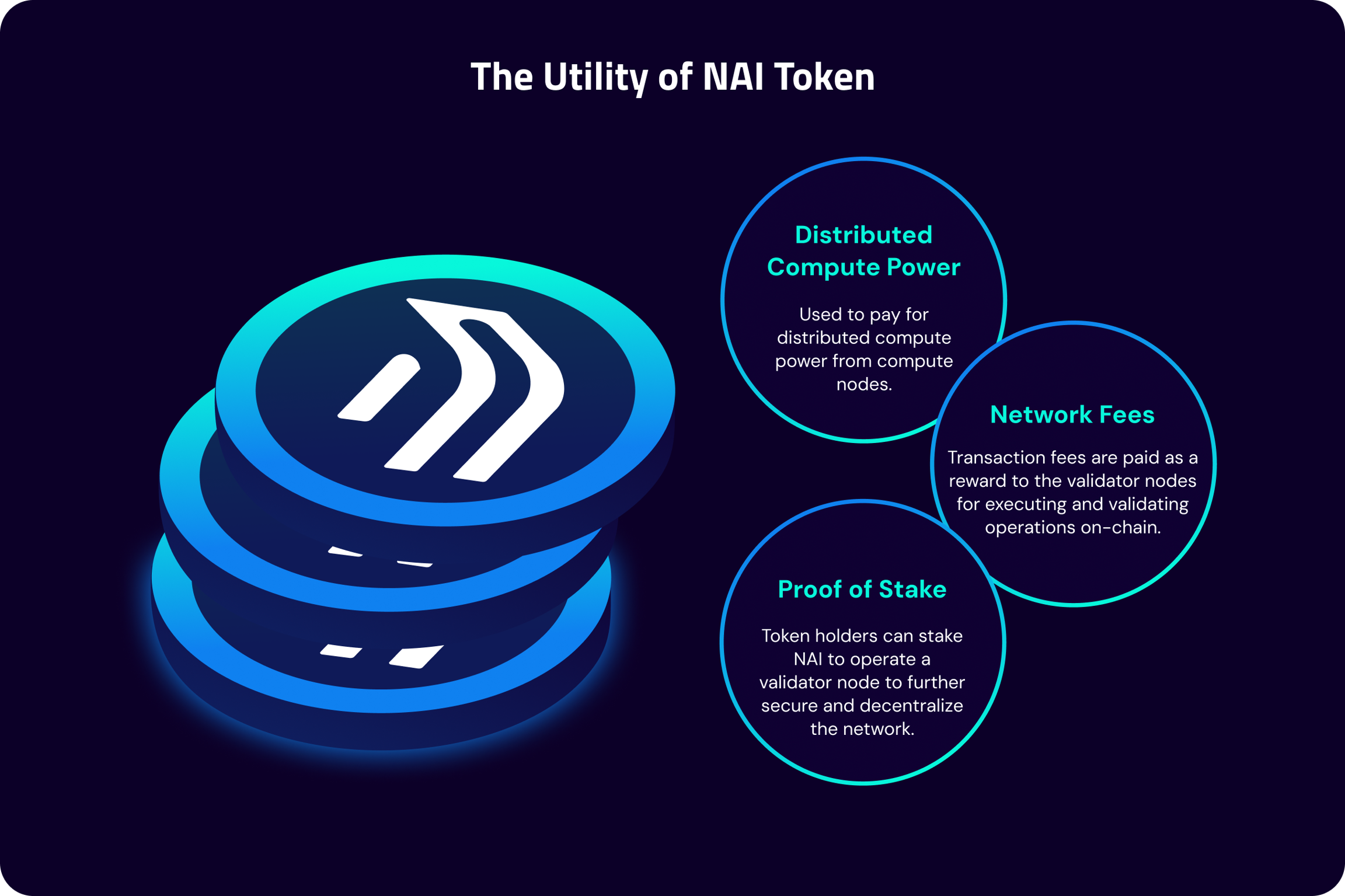
Our native token is NAI, which serves multiple purposes within our system:
- Transaction Fees: All operations on the blockchain require gas paid in
NAI - Staking: All validators stake
NAIto participate in consensus - Governance:
NAIholders can vote on proposals proportional to their holdings - Dataset Operations: Creating and managing datasets requires
NAI
Network Security
Our security model relies on:
-
Validator Set: A distributed group of validators stake
NAItokens and run nodes that validate transactions and produce blocks sequentially. -
Delegated Proof of Stake: Token holders can delegate their
NAIto validators, this specifically increases security while earning a portion of rewards. -
Slashing Conditions: Validators who misbehave (double-sign blocks or remain offline) have a portion of their stake slashed.
-
Consensus Rules: The Tendermint consensus algorithm ensures that
2/3+of validators must agree on the state of the blockchain.
// reset start height on signing infos
if err := app.SlashingKeeper.IterateValidatorSigningInfos(
    ctx,
    func(addr sdk.ConsAddress, info slashingtypes.ValidatorSigningInfo) (stop bool) {
        info.StartHeight = 0
        _ = app.SlashingKeeper.SetValidatorSigningInfo(ctx, addr, info)
        return false
    },
); err != nil {
    log.Fatal(err)
}
Interoperability
Through IBC integration, We can:
- Transfer datasets and contributions to other compatible blockchains
- Interact with other specialized chains in the Cosmos ecosystem that we choose to
- Access liquidity and functionality from connected blockchains
IBC integration is implemented with proper middleware stacking:
// Create static IBC router, add transfer route, then set and seal it
ibcRouter := porttypes.NewRouter().
    AddRoute(ibctransfertypes.ModuleName, transferIBCModule).
    AddRoute(icacontrollertypes.SubModuleName, icaControllerIBCModule).
    AddRoute(icahosttypes.SubModuleName, icaHostIBCModule)

wasmStack, err := app.registerWasmModules(appOpts)
if err != nil {
    return err
}
ibcRouter.AddRoute(wasmtypes.ModuleName, wasmStack)

app.IBCKeeper.SetRouter(ibcRouter)
Development and Testing
You as a builder can extend and interact with Helix through:
-
CLI Interface: For direct interaction with the blockchain
nuklaidnuklaid tx dataset create-dataset kiran1 KP1 test nukl.ai person mit MIT test.license true test.metadata --from alice -
REST API: For application integration
// RegisterAPIRoutes registers all application module routes with the provided API server
func (app *App) RegisterAPIRoutes(apiSvr *api.Server, apiConfig config.APIConfig) {
    app.App.RegisterAPIRoutes(apiSvr, apiConfig)
    if err := server.RegisterSwaggerAPI(apiSvr.ClientCtx, apiSvr.Router, apiConfig.Swagger); err != nil {
        panic(err)
    }
    docs.RegisterOpenAPIService(Name, apiSvr.Router)
} -
gRPC Endpoints: For efficient programmatic access
app.GRPCQueryRouter() -
CosmWasm Contracts: For your custom on-chain logic
// Mint 1000 tokens to address
{
  "name": "Shodipo Ayomide",
  "symbol": "SAY",
  "decimals": 6,
  "initial_balances": [
    {
      "address": "nuklai13fy0hfyy5h9zxmkukfx48j0m84kyl7qpcljh5h",
      "amount": "1000000000"
    }
  ]
} -
Transaction Submissions: For creating new NFT, FT, datasets, contributions, and transfers
// In code, we provide helper functions for transaction creation
contributionId := types.ComputeContributionID(msg.Denom, msg.DataLocation, msg.DataIdentifier)